

2026-27 Enacted Budget: Initial Summary
Budget Rides Artificial Intelligence (AI) Tax Coattails. Tax revenues associated with the AI industry continue to shore up California’s budget, at least for now. Compared to the Governor’s January proposal, the enacted budget reflects General Fund tax revenues that are $18 billion higher over the three-year budget window through 2026-27 and into the future, as illustrated in the chart below. This increase in tax revenue is, for the moment, allowing for unsustainable spending growth.
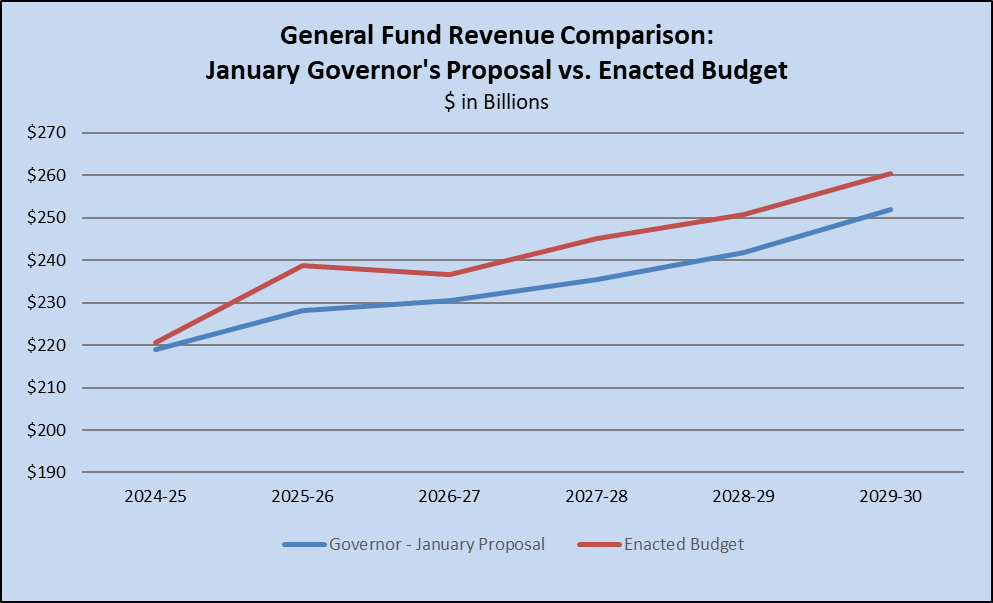
Spending Reaches Record High. The enacted budget includes General Fund spending of $251 billion, an increase of 2.5 percent over 2025-26. Over Governor Newsom’s tenure, General Fund spending would grow by 79 percent under this budget (comparing 2026-27 to 2018-29; not adjusted for inflation). The chart on the next page illustrates this dramatic growth. General Fund revenues in 2026‑27 would reach $237 billion, a slight drop of about 1 percent from 2025-26. During Governor Newsom’s time, General Fund revenues have grown by 65 percent, which, although substantial, is not enough to keep pace with the majority party’s spending spree.
State special funds add another $100 billion in spending, bringing total state spending to $351 billion. Federal funds of $187 billion are also reflected, which would bring the grand total to $538 billion.
Tax Increases, Borrowing, and Reserves Prop Up Record Spending. The enacted budget reflects $13 billion in budget “solutions” through new tax increases, borrowing, and additional use of reserves for 2025-26 and 2026-27. Specifically, these include the following:
-
Tax increases of $3.9 billion in 2026-27, which would increase to $5.1 billion by 2027-28. These include the following:
$1 billion in 2026-27 by extending the current cap on business tax credits an additional three years. This is estimated to increase General Fund revenues by $3.3 billion in 2027‑28. Beginning in 2030, the business cap will become permanent, with businesses able to claim up to $5 million or 70 percent of tax liability, whichever is greater.
$450 million by broadening sales taxes to include certain software services, which would rise to $900 million by 2029-30. This sales tax increase would also raise local tax revenue by $560 million in 2026-27 and $1.1 billion annually.
$575 million by implementing a new structure for the managed care organization (MCO) taxes starting in 2027. The revenue increase would rise to $2.3 billion in 2027-28.
$1.9 billion from “excess” revenues associated with the existing MCO tax.
$3.9 billion in borrowing known as a “settle-up obligation” that results when the state does not fully fund the Proposition 98 funding guarantee for TK-14 education.
$5.4 billion by increasing the suspension of the deposit into the Rainy Day Fund in 2025-26. The effect of suspending the deposit is similar to withdrawing funds from reserves, a move that makes no fiscal sense during a time of rising tax revenues.
The budget also includes a small amount of spending reductions reaching the low hundreds of millions of dollars and fund shifts of a similar amount. (Precise figures for these actions were not available at the time of publication.) Reserves, borrowing, and fund shifts are one-time “solutions” that do not improve the budget’s long-term viability.
Insufficient Spending Solutions Leave Long-Term Deficits, Despite Higher Revenue. The Governor’s January budget proposal estimated a deficit of $2.9 billion for 2026-27 and a much larger deficit of $22 billion for 2027-28. The enacted budget now reflects budgets that are technically balanced in 2026-27 and 2027-28, as indicated by ending balances totaling $4.5 billion and $403 million, respectively, in the Special Fund for Economic Uncertainty (SFEU). A major factor in this improvement is retroactive recognition of higher-than-expected tax revenues for 2025-26, creating a large carry-in balance of $57 billion going into 2026-27.
While striving to achieve balance in future years is commendable, the lack of significant, ongoing spending reductions means that revenues and expenditures would remain fundamentally out of balance for the duration of the budget forecast. The annual deficits, which range from $8 billion to $18 billion in future years, mean that additional actions must be taken to achieve a truly sustainable budget, even if there is no significant reduction in anticipated tax revenues.
Money Wasted on Special Interests and Allies While Critical Safety Needs Unaddressed. The budget falls far short of addressing needs such as financially distressed hospitals on the brink of closure and sufficient funds for implementing Proposition 36 treatment. However, somehow, the Governor and Democrats found more than $200 million in handouts to narrow interests and politically friendly nonprofits with little to no discussion of the amounts awarded. Such handouts range from under a million to the low tens of millions of dollars, but funds in those ranges would certainly help hospitals on the brink of closure. The budget also would spend over $140 million on projects that appeared at the last minute with no prior discussion in any legislative hearing. (Some spending items appear on both lists, so the two amounts are not mutually exclusive.) Some of the last-minute items may have individual merit, but the proposals were never publicly discussed and weighed against other needs.
“Wall of Debt” Belies Governor’s Claims of Balanced Budgets. The nonpartisan LAO documented in a February 2026 report how Governor Newsom and legislative Democrats rebuilt the “Wall of Debt” in recent budgets to pay for ongoing spending. Governor Jerry Brown had reduced the Wall of Debt to $2 billion by the end of his tenure, but Governor Newsom and legislative Democrats drove that debt back up to $29 billion. Use of budgetary borrowing to this degree demonstrates that California’s budget is only balanced according to a technical definition. Any family with common sense would recognize that amassing credit card debt to pay regular bills cannot be considered keeping a budget in balance. Governor Newsom’s last budget will leave that debt for future taxpayers to address.
The Wall of Debt balance is in addition to the $19 billion debt owed to the federal government for unemployment insurance claims. California is the only state that failed to pay off its debt following the pandemic. As a result, employers face steadily increasing taxes to pay down the debt balance, while the state General Fund must pay the annual interest, amounting to $668 million in the upcoming year.
Budget Spends Down Reserves Despite Higher Tax Revenues. Despite tax revenues that have increased each year, the enacted budget continues to make use of $14 billion in budget reserves in 2025-26, including a suspended deposit of $7.0 billion and a withdrawal of $7.1 billion. The 2024-25 budget also used $6.5 billion in reserves, bringing the total use of reserves over that two-year window to nearly $21 billion. This use of budget reserves occurred while revenues increased by nearly $42 billion over the two years from 2023-24 to 2025-26. This absurd use of budget reserves illustrates weaknesses in the current constitutional rules regarding reserve withdrawals as well as the foolish fiscal management by the Newsom administration.
The enacted budget reflects total reserves of $29 billion, including the following:
$15 billion in the constitutional Budget Stabilization Account (also called the Rainy Day Fund). This includes $13.3 billion in mandatory deposits, which represent 5.7 percent of General Fund revenues.
$4.5 billion in the Special Fund for Economic Uncertainties, which may be thought of as the state’s checking account balance.
$9.2 billion in the Proposition 98 school reserve
The budget also makes use of the recently established Projected Surplus Temporary Holding Account, a legislatively created account intended to shift resources forward by one year. The budget places $6.4 billion into this account in 2026-27 for expenditure in 2027-28, which helps to keep that year in technical balance.
Ballot Measure Proposes Changes to Reserve and Debt Payment Rules. The Legislature passed Assembly Constitutional Amendment (ACA) 20 on June 25, 2026, to place a measure on the November ballot that would change the rules for deposits and mandatory debt reduction payments. Most notably, the measure would:
Raise the cap on mandatory reserve balances in the Rainy Day Fund from 10 percent of General Fund tax revenues to 20 percent.
Set up a larger budget set-aside when taxes from capital gains exceed 10 percent of General Fund revenues.
Allow debt payments from the set-aside to go toward the Unemployment Insurance debt as well as to current and future budgetary borrowing. Allowing debt payments to go toward future budgetary borrowing is a significant difference from the 2014 reserve measure (titled Proposition 2 that year), which permitted debt payments to only go toward budgetary borrowing that already existed at that time.
Leave in place the current rules regarding reserve withdrawals and deposit suspensions.
Place into the state constitution the Surplus Temporary Holding Account and treats deposits and withdrawals from it similarly to the Rainy Day Fund.
Exempt reserve deposits from the state spending limit, sometimes called the Gann limit, but count withdrawals from reserves against the spending limit. This reverses the current rule.
Tax Policy
Expansion of Sales and Use Tax. The budget expands the state’s sales and use tax to include sales of digital prewritten software, regardless of how the product is delivered to the purchaser. and Software-as-a-Service products. While many businesses across California are impacted, the tax expansion will hit the state’s hospitals particularly hard. This change taxes the core tools hospitals use to provide patient care. Without a targeted exemption, hospitals will be asked to absorb a significant new operating cost. The state is appropriating tens of millions of dollars from the General Fund to keep struggling hospitals solvent. Taxing their essential software would undercut that investment and offset some of those state dollars through the back door, all while accelerating the financial distress the majority party claims it is working to prevent.
Limitation on Business Tax Credits, Including Research and Development. Currently, business tax credits claimed under the Personal Income Tax Law and the Corporate Tax Law may not exceed $5 million for each of the taxable years 2024, 2025, and 2026. The budget extends the business tax credit cap at $5 million for three years. For each of the 2027, 2028, and 2029 taxable years, the budget allows a taxpayer to make an irrevocable annual election to receive a refundable tax credit in the amount of the credit over the $5 million cap.
After the three-year extension noted above, beginning with tax year 2030, the budget establishes a permanent business tax credit limitation that is the greater of $5 million per corporation per year or 70 percent of a corporation’s pre-credit tax liability. Refundable credits generated under the limitations in 2024 through 2026 may continue to be claimed, in addition to the credit cap and refundable credits generated under the bill’s limitations in 2027 through 2029. If a taxpayer cannot use all of its credits because of the limitation, the unused amount is not lost. It becomes a credit carryover that can be used in future years.
While preserving the refundability of previously earned business tax credits may temporarily mitigate the impact of establishing a permanent cap on business tax credits, this measure offers only short-term relief. Once those refundable credits have been exhausted, businesses across the state will face lasting financial harm, reduced investment capacity, and diminished competitiveness as the permanent cap continues to constrain their ability to recover and grow.
Reduces First-Year Tax for New Businesses. The budget reduces the $800 annual tax paid by limited liability companies (LLCs), limited partnerships (LPs), and limited liability partnerships (LLPs) in their first year of existence to $400 for tax years 2027, 2028, and 2029, and would result in a General Fund revenue loss of approximately $100 million annually. This would be a small reduction in the startup costs for entrepreneurs and small business owners.
Senior Citizens and Disabled Citizens Property Tax Postponement Program. The budget allows the State Controller to utilize up to $300,000 of the amount available in the Property Tax Postponement Fund for residential dwellings that are manufactured homes. The program was established to allow certain senior citizens and disabled persons to defer property tax payments for residences. The State Controller utilizes monies in the fund to cover property tax obligations on behalf of qualifying individuals, with eventual repayment secured by a lien against the respective property.
CalCompetes Tax Credit Extension. The budget extends the $180 million per year CalCompetes Tax Credit program within the Governor’s Office of Business and Economic Development through 2035. In a 2026-27 budget report, the Legislative Analyst’s Office noted that recent evidence from academic research has found that the California Competes tax credit is relatively effective at increasing employment and providing an economic benefit to the state, especially relative to other tax expenditure programs in California and elsewhere.
New Managed Care Organization (MCO) Tax Harms Californians. The budget relies on $575 million in new revenue in 2026-27 (and $2.3 billion annually through 2030) from a new MCO tax on both Medi-Cal managed care plans and commercial health insurance plans. This equates to $1.5 billion in health insurance premium hikes on individuals and businesses in California. A family of four on private insurance is likely to see their health premiums increase by several hundred dollars due to this misguided policy. Additionally, this new MCO tax clearly undercuts voters’ intentions in Proposition 35 (2022) to direct MCO tax revenue towards improving provider payment rates, though the Newsom administration believes it has found a legal loophole.
Studying a New Employer Payroll Tax. The budget includes $1 million for the Department of Finance to study and produce draft bill language in 2027 to impose a burdensome "Fair Share" Tax on California businesses to increase Medi-Cal funding.
No Medi-Cal Managed Care Plans for the Undocumented. The budget reflects $472 million in General Fund savings from the transition of undocumented Medi-Cal beneficiaries from managed care plans to the fee-for-service system. The budget also appropriates $39 million for care coordination resources and navigators to aid in this transition. Undocumented adults will also begin to pay a premium of up to $50 a month in 2027.
Delays Budget Solutions to Reduce Undocumented Care Medi-Cal Costs. The budget reflects costs of $1.3 billion to delay two policies until July 1, 2027: (1) the elimination of prospective payment system reimbursement for community clinics for services to the undocumented, and (2) the elimination of dental benefits for undocumented Medi-Cal beneficiaries.
Legal Immigrants Kicked off Full-Scope Medi-Cal in 2027. The budget includes $303 million in costs to fund legal immigrant populations (refugees, asylees, victims of human trafficking, etc.) in full-scope Medi-Cal for one year until July 1, 2027, when they will then be moved into restricted-scope Medi-Cal benefits (limited to emergency and pregnancy services). This action is a stark and highly objectionable contrast in that the budget will maintain full-scope benefits for illegal immigrants while shifting legal immigrants to restricted-scope benefits. This means that Governor Newsom and the Democrats are penalizing immigrants who follow the laws while rewarding those who do not. The Newsom administration claimed that the state “can’t afford” to provide full benefits to legal immigrants, even though the cost of the legal population is billions of dollars less than the cost of benefits for illegal immigrants that this budget maintains.
One More Year of Supplemental Payments to Dentists. The budget reflects costs of $258 million to delay the elimination of Proposition 56 supplemental Medi-Cal provider payments for dental services until July 1, 2027.
Lower Medi-Cal Asset Limit in 2027. The budget includes $278 million to retain the existing $130,000 Medi-Cal asset limit for 2026-27, but then the asset test will decrease to $21,000 for individuals and $31,000 for couples on July 1, 2027. The Governor initially proposed an asset limit of $2,000, so this policy takes a middle option. This will affect numerous seniors and the disabled.
County Administration Costs. The budget allocates $197 million from the General Fund to support the county administration workload for the Medi-Cal program.
Proposition 36 Behavioral Health Treatment Funding. The budget includes $20 million in funding for county behavioral health departments to continue Prop. 36 related mandatory drug treatment.
Funding for Gender Transitions. The budget allocates $10 million to cover the costs of gender transitions for the uninsured and subsidizes doctors who administer these transitions. The budget also takes the concerning step of waiving the Public Records Act to hide these contract expenditures from the public.
Hides Planned Parenthood Giveaways. The budget appropriates $40 million to support an abortion uncompensated care program and the so-called abortion “travel” fund. The budget also waives the public contract code rules and the Public Records Act for both programs to hide this special interest giveaway.
Insufficient Funding for Distressed Hospitals. The budget includes $90 million to support grants to distressed hospitals and authorizes an additional $50 million at the discretion of the Department of Finance. In addition, the budget allocates $10 million to evaluate hospitals’ financial distress across the state. This amount falls short of the $300 million for which both Senate Republicans and the California Hospital Association had advocated.
Anti-Fraud Reforms. The budget includes $68 million in savings from anti-fraud reforms to enhanced care management and community support services in Medi-Cal. In addition, the budget imposes a moratorium on new home health agency licenses to weed out fraudulent license holders.
Treatment of Menopause. Implements health insurance coverage requirements for perimenopause, menopause, and postmenopausal care in both commercial health plans and in the Medi-Cal program.
Mobile Crisis Benefit Funded. The budget appropriates $42 million to continue the community-based mobile crisis services benefit in Medi-Cal until June 30, 2027.
Questionable Diaper Contract Continued. The budget contains a public contract code exemption for the Diaper Access Initiative to continue exclusive contracts with the non-profit Baby2Baby, run by friends of First Partner Jennifer Newsom. Last year's budget allocated $20 million over two years for the program.
Needles and Pipes to Addicts. The budget adds $142 million in special fund dollars for a variety of sexually transmitted disease prevention programs, needle and other drug paraphernalia exchange programs, and transgender mental health programs. Note that this amount exceeds what Governor Newsom and Democrats were willing to provide to distressed hospitals.
Record Proposition 98 Funding. The Proposition 98 TK-14 guarantee levels are $128 billion for the 2026-27 fiscal year, $125 billion in 2025-26, and $125 billion in 2024-25. In the 2025-26 fiscal year, the budget underfunds the guarantee by $3.9 billion, for a total guarantee of $121 billion, creating a “settle-up” obligation. The budget contains language that would require 33 percent of any higher-than-forecasted tax revenue (outside Propositions 98 and 2) for fiscal years 2025-26, 2026-27, and 2027-28 combined to be appropriated to pay all or part of the settle-up obligation.
Proposition 98 Reserve and Local Control Funding Formula. The budget projects a final balance in the Public School System Stabilization Account (Proposition 98 Reserve) of $9.2 billion at the end of 2026-27. This includes a mandatory deposit of $8.7 billion with a discretionary deposit of $500 million. The budget also adopts a 4.31 percent cost-of-living adjustment (COLA) for the Local Control Funding Formula, resulting in an increase of $2.2 billion in funding for schools. This is 1.44 percent above the statutorily required 2.87 percent COLA. The “super cola” is included to cover the paid pregnancy leave mandate, which is discussed later in this section.
Major Funding Increase for Special Education. The budget includes an increase of $2.4 billion ongoing for special education, an increase of 43 percent, bringing the per-pupil base rate to $1,340. The Legislative Analyst’s Office previously noted that local funds are currently covering about 60 percent of special education costs, and this proposal could reduce that by 12 percent.
Student Support and Professional Development Discretionary Block Grant. This budget appropriates $5 billion in one-time Proposition 98 General Fund for the Student Support and Professional Development Discretionary Block Grant, $626 million in the main budget bill, SB 111, and $4.4 billion in the TK-12 Trailer Bill, AB 126. The funding is intended to help with rising costs, career pathways and dual enrollment expansion efforts, teacher recruitment and retention, and professional development for teachers on the frameworks in mathematics, English language arts, and literacy. Providing a one-time discretionary block grant provides Local Education Agencies (LEAs) more flexibility to cover costs that are specific to that LEA's priorities without creating ongoing funding pressure.
Requires Paid Pregnancy Leave. The budget requires a school district, county office of education, charter school, or educational joint powers authority to provide up to 14 weeks of leave of absence with specified pay benefits because of pregnancy, miscarriage, childbirth, termination of pregnancy, or recovery from those conditions. A “super cost-of-living adjustment (COLA)” of 1.44 percent is provided to cover the cost of the requirement. While the administration notes that the requirement will be covered by the super “COLA”, the LAO previously noted that there is uncertainty around the cost, but it would likely be tens of millions for community colleges and hundreds of millions for school districts. However, it should be noted that the super COLA increases the funding received by the LEAs, regardless of the cost of their employees taking paid pregnancy leave. This means that LEAs could end up with more discretionary funding if their leave-of-absence costs are below their super COLA allocation. There are also major concerns that one of the allowances for the use of the leave is "termination of pregnancy". This raises the question of whether or not the state should be using taxpayer dollars to cover the cost of leave for abortions.
Fully Restores Funding for the Learning Recovery Emergency Block Grant. The budget restores $757 million from the Proposition 98 General Fund for the Learning Recovery Emergency Block Grant. This block grant was previously reduced in the 2023 Budget Act by $1.6 billion. Intent language was included in the 2023-24 budget to begin restoring the funding by $379 million per year, beginning in 2025-26 and continuing through 2027-28, for a total restoration of $1.1 billion. This appropriation is the final installation in that restoration process and restores the funding one year earlier than planned.
Delays the Repayment Period for the Proposition 98 Maneuver Yet Again. This budget delays the repayment period for a second time for the administration's unprecedented accounting maneuver to solve for $6.2 billion in overpayments to schools in the 2022-23 fiscal year. The payments would be delayed by one year, beginning in 2028-29 through the 2040-41 fiscal year, for 13 years of payments. When the maneuver was originally created, the payments were only supposed to run through 2035-36 and take nine years. The maneuver delayed recognizing the funding paid to schools until future years, essentially creating an interest-free loan from the state’s cash reserves. The payments are being recognized as General Fund, instead of Proposition 98 General Fund, creating General Fund obligations in future years, which already have projected deficits.
Continues Subsidized Preschool Eligibility Regardless of Income Change. The budget would use a family’s initial income eligibility to establish ongoing income eligibility, regardless of an increase in the family’s income. While some might argue this proposal would allow for more consistency in services being provided to families, the state has limited resources. Programs such as state preschool should be provided for only those who show adequate need. Every dollar that goes toward families who do not meet the income eligibility requirements is a dollar taken from other laudable education policy goals.
Shifts All California State Preschool Programs Under Proposition 98. The budget shifts non-LEA state preschool programs into Proposition 98. The budget re-benches Proposition 98 to account for this shift. The re-bench process involves pulling more General Fund into the Proposition 98 guarantee. These programs were previously covered by the non-Proposition 98 General Fund.
Community Colleges Receive Significant Increase. The community college budget would reach just over $10 billion from the Proposition 98 General Fund in 2026-27, an increase of $1.3 billion, or 15 percent, over the 2025-26 level. This increase includes the following significant changes:
Amending the Student-Centered Funding Formula to base colleges’ budgets on the greater of their most recent enrollment year or their three-year average. This change should help faster-growing districts and add $48 million to the budget.
Providing a mandatory cost-of-living adjustment (COLA) of 2.87 percent plus a “super COLA” of 1.44 percent, consistent with TK–12 Education.
Mandating that colleges provide up to 14 weeks of leave for pregnancy, childbirth, termination of pregnancy, and related conditions. The so-called super COLA is intended to pay for the costs of this mandate. The budget includes $13 million specifically targeted to cover this mandate for “hold harmless” college districts that would not otherwise receive the COLA.
Appropriates $147 million from the Proposition 98 General Fund for the Student Support Block Grant through the Higher Education trailer bill, SB 135.
Requires the Community College Chancellor’s Office to establish the Credit for Prior Learning Initiative as a systemwide initiative to award credit for prior learning opportunities at community colleges, among other conforming changes.
Provides Proposition 98 funding targeted to specific groups, including $30 million one-time for LGBTQ+ Resource Centers and $70 million one-time for Dream Resource Centers.
Includes nearly $43 million in one-time Proposition 98 General Fund for the California Indian Nations College.
Public University Systems. The budget largely approves the Governor’s proposals for the University of California and the California State University systems. This includes the following key items:
Providing $519 million for a 5 percent base increase, representing the fifth and final year of the compacts with the two systems.
Providing only partial funding for the fourth year of the compacts, thus continuing to defer $293 million for the two systems.
Delaying repayment of the prior base deferral, totaling $274 million, until 2027-28. Interest-free loans remain available to help the universities mitigate this cut.
Financial Aid (Student Aid Commission). The budget updates Cal Grant spending for caseload changes and makes the following significant policy changes:
Housing
Multifamily Housing Program. The budget provides $200 million from the General Fund for the Multifamily Housing Program, which provides low-interest loans for new construction, rehabilitation, and preservation of rental housing for lower-income households. Previously, the program received $1.5 billion in bond funds authorized by the Veterans and Affordable Housing Bond Act of 2018 (Proposition 1), but as those bond funds have been fully expended, the state has provided General Fund to support the program in recent years. In 2025-26, the budget included $120 million for the Multi-Family Housing Program.
Federal Budget Bill Offers New Resources for Affordable Development. H.R. 1, the federal legislation enacted last summer, offers new resources for affordable housing. Prior to the enactment of H.R. 1, affordable housing developers needed to finance at least 50 percent of their projects with private activity bonds in order to gain access to 4 percent tax credits. H.R. 1 reduced this threshold to 25 percent, effectively doubling how many 4 percent tax credits California projects can draw down each year using the same amount of private activity bonds. This change could yield as much as $4 billion in additional 4 percent affordable housing tax credits in California every year. Additionally, H.R. 1 increased the size of the 9 percent tax credit program by 12 percent indefinitely, which translates to about $150 million more in 9 percent tax credits for California annually.
Restructures State’s Affordable Housing Financing Programs. The 2026 budget significantly restructures how the state awards its affordable housing funding. In California, state funding for the construction of affordable housing can come from several different departments and multiple different programs. To add to the complexity, the last layer in nearly every affordable housing capital stack consists of tax-exempt private activity bonds and tax credits awarded by the California Debt Limit Allocation Committee (CDLAC) and the Tax Credit Allocation Committee (TCAC), respectively, both of which are part of the State Treasurer’s Office. The changes included within the 2026 budget move the state towards a coordinated access point for housing funding, which could move California closer to a one-stop shop for affordable housing developers seeking capital for projects.
Waiving Local Impact Fees Creates Pros and Cons. A new housing development will generally increase effects like wear and tear on local roads, the amount of effluent that will flow through local sewers, local demand for utilities, and the number of children attending local schools. To offset the associated costs, local jurisdictions frequently charge the project builder “impact fees.” The budget includes changes in the imposition of these local development impact fees on state-funded affordable housing projects. Budget trailer bill AB 179 makes the following policy changes related to these fees and affordable housing developments:
Treats any waiver or reduction of development impact fees as a local contribution to an affordable housing project. The Newsom administration believes that this would make projects more competitive when seeking state funding for housing developments, since local contributions can boost a project’s points within the application scoring system.
- Prohibits local jurisdictions that are seeking state housing funds for their own projects from imposing development impact fees.
This policy creates complex trade-offs. Developer fees drive up the cost of projects and therefore make housing less affordable, but many localities have come to rely on them for additional revenue.
Low-Income Housing Tax Credit Program. The budget provides $630 million in 2026-27 for the Low-Income Housing Tax Credit (LIHTC) program, which provides supplemental tax credits within the State Housing Tax Credit program. The LIHTC works in conjunction with two federal tax credit programs to reduce funding gaps within development projects. The program offers developers nonrefundable and transferable tax credits to subsidize the construction and rehabilitation of housing developments that have strict income limits for eligible tenants. This enables affordable housing developers to secure a critical portion of the funds they need in order to make the construction and operation of properties financially viable.
Disaster Relief Program. The budget provides $100 million ($56 million General Fund, $44 million National Mortgage Settlement Fund) for the new Disaster Relief Program within the California Housing Finance Agency to assist homeowners seeking to rebuild in the wake of natural disasters, such as wildfire, through a combination of a loan loss guarantee program, an interest rate buydown program, and other tools intended to reduce borrowing costs and facilitate access to private financing. CalHFA would look to achieve that aim through a variety of subsidy mechanisms, including loan loss reserve, interest rate buydown, below-market-rate subordinate loans, among other tools yet to be determined.
Homelessness
Budget Includes Homelessness Funding but Also New Match Requirements. The budget provides $900 million for Round 7 of the Homeless Housing Assistance and Prevention Program ($500 million included in the 2025 Budget Act and an additional $400 million included in the 2026 Budget Act). The distribution of the funding would be subject to several layers of performance metrics and outcome data.
Pursuant to SB 158 (Stats. 2025), the 2025 Budget Act included $500 million for Round 7 of HHAP, available as of July 1, 2026, and made the funding contingent upon the enactment of legislation providing the administrative framework for the newest round. The 2026 budget includes the administrative framework required by SB 158. Among other new requirements, the budget requires local jurisdictions to provide matching funds in order to receive Round 7 HHAP funds, 35 percent of the first award level, increasing to 70 percent for the second distribution.
In addition to the new local match requirement, the budget includes another significant change in HHAP requirements for Round 7 of funding. Cities that are HHAP recipients and the counties in which those cities are located must now obtain a Pro-Housing Designation within a year of their first disbursement, or HCD will reallocate any remaining funding from the recipient. Currently, a Pro-Housing Designation gives cities and counties a scoring advantage when they apply for certain state funding, but it is not a state requirement. As of March 2026, nine of the 14 cities receiving HHAP funds (and 5 of the 11 counties where those cities are located) have a Pro-Housing Designation.
Natural Resources and Environment
Greenhouse Gas Reduction Fund/Proposition 4. The enacted budget (SB 111) funds selected climate and air quality programs with available Greenhouse Gas Fund (GGRF) revenues while repealing the contingent $2.6 billion Proposition 4 bond appropriation. The remaining GGRF and Cap-and-Invest spending plan was deferred to a separate budget trailer bill expected in August, postponing legislative consideration of significant climate-related expenditures.
Wildfire and Forest Resilience: The budget provides funding for CalFire operations, aviation, defensible space enforcement, home hardening, public education, and selected forest resilience activities. Many wildfire prevention programs are now supported through Proposition 4 bond funding rather than the larger one-time General Fund appropriations provided in prior years. Major appropriations include:
$1.25 billion Greenhouse Gas Reduction Fund for CalFire state operations and fire protection.
$67 million General Fund annually (growing to $74 million ongoing) for increased fixed-wing pilot and mechanic contract costs supporting CalFire's aviation fleet.
$6.2 million General Fund and 31 positions to support CalFire's defensible space inspection program and achieve the goal of 250,000 parcel inspections annually.
$5 million from the General Fund to the Office of the State Fire Marshal for a statewide home hardening inventory.
Zero-Emission Vehicles and Climate. Rather than advancing major policy proposals through the regular committee process, the majority continues to rely on budget trailer bills to enact substantive policy with compressed timelines and limited public review. This year's budget creates a new $136 million zero-emission vehicle incentive program through the budget process instead of the normal policy process, reducing transparency and limiting the Legislature's ability to fully vet the proposal before enactment.
The budget also provides $150 million from the General Fund for the Community Air Protection Program (AB 617), $51 million from the GGRF for State Air Resources Board support, and additional GGRF appropriations for the Clean Off-Road Equipment Voucher Incentive Project (CORE) and other climate and air quality programs.
Parks and Recreation. The budget emphasizes core park operations, public access, and stewardship of existing state recreation assets while continuing state spending on local recreation and restoration projects, including:
$24 million for operations and transition activities at Will Rogers State Beach and Dockweiler State Beach
$29 million Off-Highway Vehicle Trust Fund for local assistance grants
$12 million Proposition 68 for the Statewide Park Program
$11 million for Redwoods Rising restoration projects.
The budget also authorizes the Department of Parks and Recreation to negotiate new concession agreements with existing concessionaires at Will Rogers State Beach and Dockweiler State Beach.
Water, Fish & Biodiversity. The budget makes the following adjustments in water infrastructure, flood protection, ecosystem restoration, and biodiversity:
$142 million for South Delta Gates projects
$25 million General Fund for the Healthy Rivers and Landscapes Program (Voluntary Agreements)
$16 million for Salton Sea habitat restoration.
The budget also provides $8 million from the General Fund for biodiversity conservation, including $6 million to establish Delta watercraft decontamination sites to help prevent the spread of invasive golden mussels. Unlike many areas of the budget, this funding primarily supports core state responsibilities, including water infrastructure, flood protection, ecosystem management, and protection of critical water resources.
Food and Agriculture. The budget makes the following adjustments in agricultural resilience, climate initiatives, food systems, and pest prevention:
$25 million for Farm to School and Local Food Systems initiatives
$23 million General Fund for the Enteric Fermentation Incentive Program
$12 million General Fund for the Healthy Soils Program
$11 million for Plant Health and Pest Prevention Programs
$8.3 million for the Industrial Hemp Program
$4 million General Fund for the Invasive Fruit Fly Program
$2.5 million General Fund for the Managed Honeybee Health Program.
With multiyear structural deficits projected to continue, new General Fund spending should be reserved for the state's highest priorities. As the nonpartisan Legislative Analyst's Office stated in the Governor’s Budget, the Farm to School and Local Food Systems initiatives and Enteric Fermentation Incentive Program do not meet the recommended threshold for new spending, raising questions about whether these programs should take precedence over core public safety, health, human services, and infrastructure needs.
Energy and Utilities
Pursuing Minimum Supply Inventories for Gasoline Refiners. The budget includes $1.9 million and eight positions for the California Energy Commission to continue efforts to impose minimum supply requirements on gasoline refiners, as authorized in AB X2 1 (Hart, 2024). Since in-state refining capacity is already inadequate and continues to decline, these regulations are likely to result in refiners withholding gasoline from the market or importing additional supply to meet the inventory requirements. These measures are likely to further increase the price of gas in California, which is already the most expensive in the nation.
Transportation
No Gas Tax Relief. The budget does nothing to provide relief at the pump for Californians. Instead, under business as usual, the gas and diesel taxes will rise on July 1, 2026, by 2.2 cents per gallon (cpg) and 1.6 cpg, respectively, because of the annual inflationary adjustment. As a result, the state is expected to collect an additional $331 million in gas and diesel tax revenues, bringing total revenues for these two taxes to $9.7 billion in 2026-27.
Continuing to Green the Caltrans Fleet. Over the past four years, the budget has provided $1.4 billion in additional funding for Caltrans to replace and upgrade its fleet, with a preference for adding zero-emission vehicles (ZEVs). Still, Caltrans asserts, “Additional funding is imperative to Caltrans’ goal of becoming the greenest fleet in the nation…” This budget adds another $225 million for this purpose, bringing the total to more than $1.6 billion. The money for these vehicles comes out of dollars that would otherwise be spent on transportation projects. With California ranking next to last in the country for overall road condition, it would seem Caltrans’ goals are misplaced. After all, as the state’s transportation department, one might assume a functional, safe transportation system would be its top priority.
Continues to Fund the High-Speed Rail Project; New Secrecy Approved. Despite bipartisan concerns raised over the project’s 2026 Business Plan, the budget continues to fund high-speed rail, with anticipated expenditures of $1.5 billion in 2026-27. The project has a funding gap estimated at $192 billion to complete the line from San Francisco to Los Angeles/Anaheim, as originally promised and approved by voters in 2008. Ignoring the project’s troubles, the budget package also includes trailer bill language in SB 169 authorizing project reports and audits to be withheld from the public under the guise of project risk.
Freezes the $1 Billion Continuous Appropriation for High-Speed Rail. The budget (AB 111, Control Section 15.14) specifies that no Greenhouse Gas Reduction Funds (GGRF) may be encumbered or committed until the Department of Finance makes a written determination that sufficient money is available from the GGRF in 2026-27 to fund the Affordable Housing and Sustainable Communities Program and the Transit and Intercity Rail Capital Program levels previously adopted ($800 million and $400 million respectively). While this provision is not expected to impact the project due to funding available from prior years, it does send a signal to markets about the vulnerability of this funding, which could hamper efforts to securitize future GGRF funds. Negotiations regarding the Cap and Invest program and GGRF revenues are expected to continue, with a resolution potentially emerging sometime in August that would unfreeze the funding.
Proposition 36 Implementation Funding. The enacted budget provides $50 million in new one-time General Fund support to continue implementation of Proposition 36 (2024), the key public safety initiative supported by 68 percent of California voters to crack down on drug and property crime while providing treatment services for drug offenders. The $50 million includes $10 million for court workload, $20 million to restore the devastating cut to pretrial services in 2026-27, and $20 million for behavioral health treatment. While this is certainly better than the Governor’s proposal, which failed to include any new funding for Proposition 36, it is well short of the $350 million estimated to be the annual Proposition 36 need.
Prison Closures. This budget reflects General Fund savings of $91 million in 2026-27 and $138 million annually thereafter due to the closure of the California Rehabilitation Center in Norco, the fourth prison to close since 2021. The Legislature contemplated language requiring the Newsom administration to identify a fifth prison for closure, but that language was not part of the final budget deal. The passage of Proposition 36 by more than two-thirds of California voters in 2024 signals that Californians are fed up with pandering to repeat criminals. If more tough-on-crime initiatives like this follow, the California Department of Corrections and Rehabilitation (CDCR) could quickly find itself in a position of needing more prison capacity, not less.
Mental Health Receivership. After decades of subpar prison mental health service delivery, in August 2025, the Coleman court ordered CDCR into receivership, suspending the state’s right to control mental health delivery in the prison system and transferring that responsibility to a new Mental Health Receiver. The budget includes $46 million ($40 million Mental Health Special Deposit Fund, $5 million General Fund, $1 million Behavioral Health Services Fund) to establish the Office of the Mental Health Receiver.
Federal Lawfare. The budget includes $27 million per year through 2028-29 for the Attorney General to sue the federal administration to slow or stop the President’s agenda. As of mid-June 2026, the Attorney General had filed 71 lawsuits against the federal administration in the 72 weeks President Trump had been in office. To date, this Trump Administration has been much more successful in its legal battles than the first Trump Administration. This suggests that the antagonistic posture the Governor and the Attorney General have assumed this time around may bring more harm than good for California.
Judgeships and Courthouses. The budget includes $100 million General Fund in 2026-27 and $44 million ongoing thereafter to fund 26 new judgeships plus the related costs of courthouse construction and modification. The judgeships were established in 2023, after years of delay, but were never funded. In addition, the budget authorizes $1.3 billion in lease-revenue bonds for courthouse construction to address the replacement or renovation of courthouses with the most immediate and critical needs, including several projects that have already been approved. This funding represents a significant bipartisan effort and a major step toward fully funding and supporting the judicial branch.
Victims of Crime Act Backfill. The budget includes $50 million General Fund to continue backfilling the ongoing reduction of more than $100 million per year since federal Victims of Crime Act (VOCA) funding peaked circa 2018. Revenues to the VOCA program declined sharply when the federal government dramatically eased prosecution of white-collar and corporate crimes. This state General Fund backfill represents a lifeline to victim programs, allowing them to continue serving crime victims to the greatest extent possible given the reduction in federal support.
General Government and Local Government
Journalism Bail-Out Continues. The budget includes $10 million General Fund for a second year, with a commitment to provide an additional $10 million in 2027-28, to provide funds to the journalism industry. The initial funding authorized in 2025-26 has not been allocated, and yet the 2026-27 budget prioritizes even more General Fund. It makes little sense to prioritize funding to a program without a clear structure, identified metrics, or a review of previous outcomes. Moreover, there are numerous struggling industries in California, and it is not clear why the budget picks this one for assistance.
California Education Learning Lab. Established in 2018 under the Governor’s Office of Land Use and Climate Innovation (GO-LUCI), the Education Learning Lab was intended to improve learning outcomes and close equity gaps across California’s public higher education segments, particularly in the Science, Technology, Engineering, and Math (STEM) disciplines. Learning Lab awards grants to support faculty-led innovations in teaching and learning that leverage technology in the teaching process. The 2025-26 budget provided $5.3 million for the Lab, but the budget stated intent to eliminate the program and funding beginning in 2026-27. Unfortunately, the elimination was short-lived, and the budget adds the program back and provides $4 million General Fund within the Government Operations Agency.
Voter Outreach and Education, Election Activities. The budget provides several last-minute budget additions for various voter and election activities, including the following:
$29 million General Fund for counties to increase the number of available staff to tabulate votes, make equipment purchases or technology upgrades, or acquire space to accommodate additional staff or equipment purchases to expedite the vote counting process and strengthen and protect election integrity.
$10 million General Fund to counties to provide voter outreach and education before the November 3, 2026, statewide general election, including with respect to the benefits of submitting ballots before election day.
$250,000 General Fund for supporting and strengthening administration of the November 3, 2026, statewide election.
While strengthening elections is laudable, the devil is in the details, which are largely absent so far. Such funding has the potential for abuse, such as the case when then-Secretary of State Alex Padilla diverted $35 million from counties to a public relations firm that touted itself as being on “Team Biden,” ostensibly for voter “outreach.”
Department of Technology-Middle Mile Broadband Initiative. The budget authorizes an augmentation of up to $22 million General Fund to the Department of Technology for the Middle Mile Broadband Initiative. The budget includes provisional language for quarterly reporting, and a revised Middle-Mile Broadband Network Business Plan to be submitted on or before February 1, 2027.
“Poppy”- California’s Digital Assistant. The budget provides $1 million to the Department of Technology in 2026–27 to support the scale-up and ongoing operation of Poppy, California’s Digital Assistant, as a shared statewide platform for broader adoption across state departments.
State Treasurer’s Office. The budget includes $1 million General Fund to the State Treasurer’s Office for the Blue Ribbon Commission to study the development of a California Department of Youth Sports.
Local Government. The 2026-27 budget includes millions of dollars in funding for a number of local projects, most of which never received any discussion in a budget hearing. The origin of these funding awards and the details have never been made public. Examples include the following:
$10 million to the City and County of San Francisco for street resurfacing.
$10 million to Los Angeles for emergency repairs to damaged roadways and street
substructures in and around Pacific Palisades.
$6.2 million to the City and County of San Francisco for the conversion of vacant property to a park.
$3 million to the Downtown Sacramento Foundation for student housing tenant improvements.
$130,000 to Los Angeles for solar-powered mobile surveillance trailers in Pacific Palisades.
Cannabis. The budget strengthens cannabis and hemp enforcement by providing $5.6 million annually for cannabis tax audit and enforcement activities and $3.3 million to expand enforcement of hemp-derived cannabinoids. The budget also maintains regulatory operations at the Department of Cannabis Control and authorizes a temporary $52 million cashflow loan to address timing differences in cannabis tax revenues.
New Funding for Veterans Affairs. The budget includes $9 million for the Southern California veterans cemetery in Orange County, $7 million for a self-reliance program for homeless veterans, $6 million in new funding for the County Veterans Services Offices, and $2 million for discharged transgender veterans.
Unemployment Insurance (UI) Debt Interest Payment. The state is responsible for interest due on money borrowed from the federal government for UI benefit payments. The outstanding loan is currently nearly $19 billion, and the budget includes an annual interest payment for 2026-27 of $668 million. In total, California has paid $1.8 billion in interest since 2021. California is the only state that failed to pay off its UI debt following the pandemic, which means private job providers in the state will be subject to annual tax increases of $21 per employee to pay off the principal of the debt. This will take years to accomplish, during which the state General Fund will continue to be on the hook for hundreds of millions of dollars in interest costs.
No Principal Payment for UI Debt but Throws a Bone. Despite racking up interest costs and the additional tax burden on employers, there is no additional principal repayment or payment plan included in this budget to pay down the remaining debt of nearly $19 billion. However, as part of the budget package, ACA 20 will place a measure on the November ballot that, if approved by voters, would authorize, but not require, the state to make additional payments on the UI debt from required budget set-asides (amending the process set up under Proposition 2 in 2014). Notably, there is nothing preventing the state from making additional payments under existing law, and additional payments will only be made under this mechanism if the majority party chooses to prioritize repaying this debt. Thus far, Governor Newsom and legislative Democrats have prioritized spending tens of billions of dollars on many other program expansions, rather than paying down the debt that the mandated shutdowns imposed on employers.
Subsequent Injuries Benefits Trust Fund (SIBTF). The budget includes an increase of $13 million and 57 positions to process backlogged claims in the SIBFT program. To encourage employment of disabled persons, the SIBTF program was designed to relieve employers of liability for additional permanent disability when an already-disabled worker suffers a subsequent industrial injury on the job. Unfortunately, the program has expanded beyond the original intent because of court decisions interpreting existing law broadly, administrative rule changes, and unintended consequences of prior workers’ compensation reforms. The budget package also includes program reforms in SB 171, a budget trailer bill, to restore the SBITF to the original intent, reducing future costs in the employer-funded injury compensation program.
Provides a Temporary Waiver for County CalFresh Match Increases. The budget caps the share of CalFresh administrative costs a county must expend in fiscal years 2026-27 through 2028-29 at its contribution in the 2024-25 fiscal year, or however much the county was required to contribute to receive its full allocation of General Fund. Under the provisions of H.R. 1, the federal government’s share of administrative costs for CalFresh will drop from 50 percent to 25 percent beginning in October 2026. The remaining administrative costs are shared between the state and counties, with counties currently covering 15 percent of the total administrative costs, growing to 22.5 percent under H.R. 1. Providing temporary relief from the increase in the administrative match will provide counties with more time to ease into the new funding structure.
Targeting Siskiyou County In-Home Supportive Services (IHSS) on Behalf of Political Allies. The budget includes language that would force Siskiyou County to come to an agreement with an IHSS employee organization or risk a 10 percent fiscal penalty on its IHSS funding from the state. While the language does not specifically call out Siskiyou County, the changes are tailored to specifically target the county. In the existing statute, a county must have a current bargaining agreement that has expired to have the existing penalty applied. Siskiyou County does not have a bargaining agreement with an IHSS employee organization, which means the county has avoided penalties without negotiating a collective bargaining agreement. The budget notes that beginning July 1, 2026, a county has 90 days to reach an agreement with the employee organization if the factfinding panel released their recommended settlement terms prior to June 30, 2026. The penalties implemented in this bill could reduce funding for other county realignment health and social service programs, like childcare and mental health.
Additional Funding for Immigration Legal Services. The budget includes $100 million in one-time General Fund to increase support for immigration legal services. When including previous ongoing baseline funding, this brings the total funding in the budget to $175 million. The budget also expands the eligibility for legal services to include “immigrant youth”, who are defined as immigrants younger than 21 in removal proceedings. The services are also expanded to include social services, which include intake screenings and assessments, coordination of care, and navigation services. Considering the costs facing the state and the demands on the budget from other laudable programs, the expansion of legal and social services for undocumented immigrants should not be a priority.
Tribal Foster Care Prevention Services. The budget establishes the Tribal Foster Care Prevention Services Initiative to assist federally recognized tribes with costs associated with providing services to keep families together and prevent children from entering the foster care system. Tribes that receive funding would be required to submit a progress report on the number of children served, the types of services provided, and how the funding has impacted the tribe’s ability to provide more services.
More Funding For CalFood. The budget includes a one-time increase of $100 million in the General Fund for the CalFood program, which provides funding for food banks to purchase, store, or transport food grown or produced in California. This increase is in addition to the CalFood program baseline funding level of $8 million General Fund, for a total funding level of $108 million.
Implements Child Care Fraud and Overpayment Provisions. This budget updates and implements provisions related to fraud and overpayment prevention in child care and development programs. According to the Department of Social Services (DSS), the laws currently governing fraud and overpayment prevention in child care programs have not been updated since the transition of the child care program from the Department of Education to DSS. The updated language would allow DSS to support contractors and cross-program investigations through collaboration with counties. Child Care is one of the fastest-growing programs in the budget, with over $7 billion in total funds, and ensuring program integrity should be a top priority.
Adds Child Care Slots and Allows the Transfer of Funding Within Programs. This budget allows DSS to transfer funding across and within certain child care and development programs. This is meant to provide flexibility and ensure that child care funding is utilized to its fullest extent and serves as many families as possible. Unspent child care funding can be the result of a number of causes, including administrative barriers, facility issues, timing, and shifts in estimates. Providing flexibility to utilize the funding across programs would help ensure families are served and that funding could be directed to where the demand is. The budget also includes $228 million from the General Fund to add 22,770 child care slots in 2026-27. Of these slots, 2,070 would be for General Child Care, and 20,700 would be Alternative Payment Program slots.
Disaster Infrastructure Grants for Child Care Providers. The budget provides DSS with the authority to issue disaster infrastructure grants to child care providers impacted by state or federally declared disasters. The budget provides $11.8 million in Proposition 64 (cannabis legalization) funds for child care facilities impacted by disasters in 2025 and $28 million in federal disaster relief funds for facilities impacted by disasters in 2023 and 2024.
CalWORKs Grant Increase. The budget includes a CalWORKs Maximum Aid Payment (MAP) increase of 1.8 percent. This increase is funded entirely by the Child Poverty and Family Supplemental Support Subaccount, a fund source that the state previously realigned to counties. While this expansion is being covered by the subaccount, it should be noted that if the subaccount ever has insufficient funding to cover this increase or any prior grant increases, the General Fund will be used to backfill the difference.
|
Bill
|
Subject (Date Enrolled or Chaptered) |
SB 106 |
Budget Act of 2025 (Chaptered February 11, 2026)
|
AB 107 |
Budget Acts of 2023, 2024, and 2025 (Chaptered February 19, 2026)
|
AB 108 |
Budget Act of 2025 (Chaptered May 7, 2026)
|
AB 109 |
Budget Act of 2026 (Chaptered June 29, 2026)
|
SB 110 |
Budget Act of 2026 (Chaptered June 29, 2026)
|
SB 111 |
Budget Act of 2026 (Chaptered June 29, 2026) |
AB 112 |
Budget Acts of 2022, 2023, 2024, and 2025 (Chaptered June 29, 2026)
|
AB 117 |
Transit and Intercity Rail Capital Program: Loans: Transit Operating Purposes: San Francisco Bay Area (Chaptered February 19, 2026) |
SB 122 |
Tax Increase (Chaptered June 29, 2026)
|
SB 125 |
Medi-Cal: Managed Care Organization Provider Tax (Chaptered June 29, 2026)
|
AB 126 |
Education Finance: Education Omnibus Trailer Bill (Chaptered July 2, 2026)
|
SB 135 |
Higher Education Budget Trailer Bill (Enrolled June 26, 2026)
|
AB 150 |
Early Care and Education (Chaptered June 29, 2026)
|
AB 152 |
Human Services (Chaptered June 29, 2026)
|
SB 163 |
Developmental Services (Amended June 26, 2026)
|
SB 164 |
Health (Chaptered June 29, 2026)
|
SB 165 |
Skilled Nursing Facilities: Reimbursement Rates (Chaptered June 29, 2026) |
SB 166 |
Public Resources Trailer Bill (Chaptered June 29, 2026)
|
SB 168 |
Energy Trailer Bill (Chaptered June 29, 2026)
|
SB 169 |
Transportation Budget Trailer Bill (Chaptered June 29, 2026)
|
SB 170 |
Governor’s Reorganization Plan No. 1 of 2025 (Chaptered June 29, 2026)
|
SB 171 |
Labor (Chaptered June 29, 2026)
|
SB 172 |
State Government (Chaptered June 29, 2026)
|
SB 174 |
Courts (Chaptered June 29, 2026) |
SB 177 |
Medi-Cal: Fair Share from Big Corporations Act (Chaptered June 29, 2026)
|
AB 179 |
Housing (Chaptered June 29, 2026)
|
SB 180 |
Taxation Trailer Bill (Chaptered June 29, 2026)
|
AB 181 |
Education governance: State Board of Education (Chaptered June 29, 2026)
|
AB 182 |
November 3, 2026, Statewide General Election: Ballot Measures (Ch. June 29, 2026)
|
Senate Republican Fiscal Staff Assignments
Kirk Feely, Fiscal Director
Office Phone: (916) 651-1501
| Assignment Area | Consultant |
|
Overall Budget, Higher Education, and State Employees
|
Kirk Feely |
| K-12 Education and Social Services |
Megan De Sousa
|
|
Public Safety, Judiciary, and Corrections
|
Matt Osterli |
|
Natural Resources & Environment
|
Jean-Marie McKinney |
| Health & Veterans Affairs |
Anthony Archie
|
| Revenue, General Government, and Housing |
Chantele Denny
|
| Transportation, Energy, and Labor |
Heather Wood
|
| Fiscal Assistant |
Armando Hernandez
|
For more information, please visit the Fiscal section of the
Senate Republican Caucus website at https://src.senate.ca.gov/news/fiscal.
Legal Disclaimer:
EIN Presswire provides this news content "as is" without warranty of any kind. We do not accept any responsibility or liability for the accuracy, content, images, videos, licenses, completeness, legality, or reliability of the information contained in this article. If you have any complaints or copyright issues related to this article, kindly contact the author above.
